336 BC
The Persian Empire of Darius III
In 336 BC, the year Alexander becomes king of Macedon, Persia also gets a new ruler. Two years earlier the Great King Artaxerxes III was poisoned by Bagoas, the eunuch who was his grand vizier, and the king's youngest son Arses was raised to the throne. Now Arses is murdered with his children, and Darius, of a side branch of the royal family by the descent Diodorus gives him, becomes king.* Diodorus tells that Bagoas then tried to poison Darius and was made to drain the cup himself. By summer 334 BC Darius III has won back Egypt and has 400 warships ready for the Aegean.
His empire reaches from Asia Minor and Egypt to Bactria in Central Asia. It is divided into some twenty provinces, called satrapies, each under a governor, the satrap. Ancient writers give only pieces of their borders. The historian Bruno Jacobs works the satrapies out from the lists of provinces that Alexander's generals shared out after his death, since Alexander had kept the Persian divisions almost everywhere. The map draws no borders between them and names a few: Hellespontine Phrygia facing Greece, Egypt, Babylonia, Persis, the Persians' homeland, Media and Bactria.
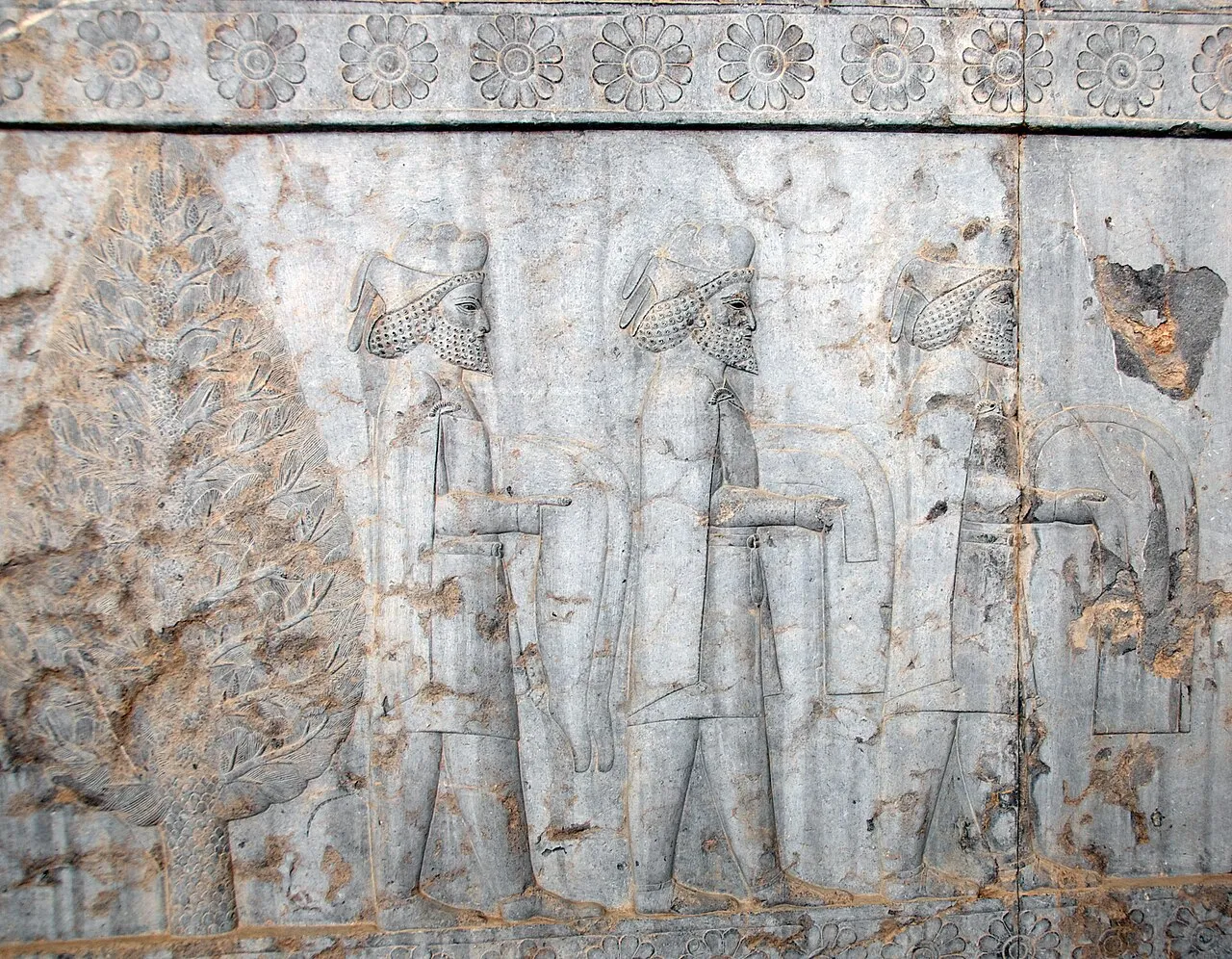 Tribute bearers of one of the subject peoples on the Apadana staircase at Persepolis, carved about 500–480 BC; photographed in 2010Wikimedia Commons, A. Davey, CC BY 2.0 (File:Tribute Bearers on the Apadana Staircase 15 (Best Viewed Size "Large") (4689038280).jpg)
A road runs from Sardis, the seat of the satrap of Lydia, to Susa, the Great King's royal city. The Greek historian Herodotus gives this Royal Road 13,500 stadia and ninety days' march; Pierre Briant, a historian of the Persian Empire, makes that about 2,500 km. Briant warns that Herodotus's account of the roads is fragmentary, and the course on the map is approximate.
Greek writers said that the Great King could no longer field a real army and had to lean on Greek mercenaries. Briant traces this picture to Diodorus, who drew on the anti-Persian historian Ephorus, and holds it untenable.
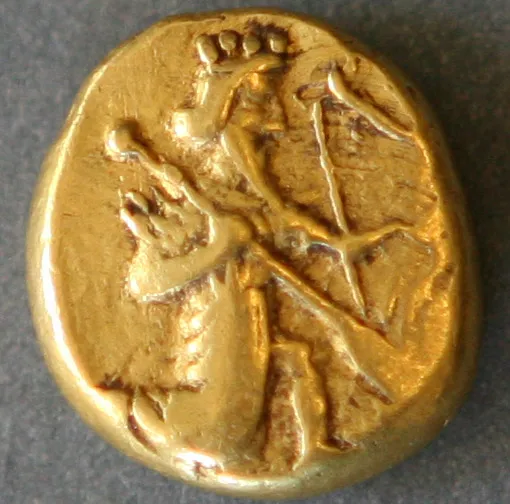 A gold daric, the coin of the Persian kings, showing the Great King as an archer; struck in the 5th century BCWikimedia Commons, Deflim, Public domain (File:Achaemenid coin daric 420BC front.jpg)
Notes
* Diodorus makes Bagoas the kingmaker: having killed Arses, he chose Darius, a man of the court, expecting to rule through him. Bosworth and Badian follow this account. Briant warns against giving Diodorus's all-powerful eunuch too much weight. In his view Darius, who had belonged to the king's inner circle for years, was the real head of the plot and Bagoas only his helper, whom Darius removed once he was king.
Sources
- Pierre Briant, From Cyrus to Alexander: A History of the Persian Empire (2002), ch. 9 and 17.
- Bruno Jacobs, "Achaemenid Satrapies", Encyclopaedia Iranica (2006).
- Ernst Badian, "Darius III", Encyclopaedia Iranica (1994).
- A. B. Bosworth, Conquest and Empire: The Reign of Alexander the Great (1988), ch. 2.II.
Prev: Hegemon of Greece, and death at AegaeNext: Rivals removed, the League renewed